
AI Receptionist for Service SMBs: How Missed Calls Can Cost up to $126,000/Year
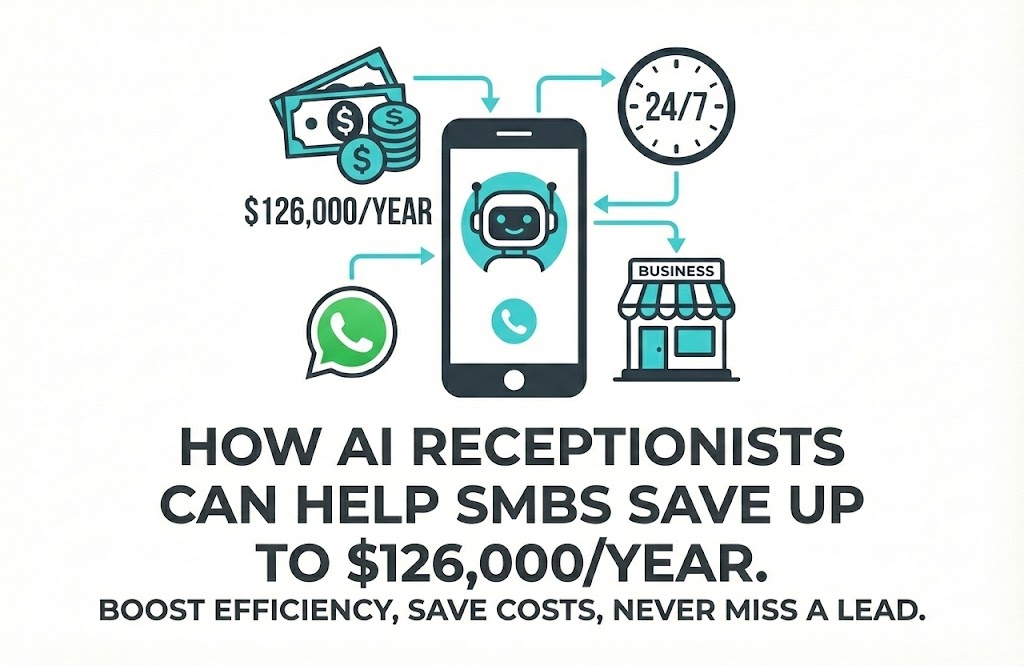
62% of calls to service SMBs go unanswered, costing the average service business $126,000 annually in lost revenue. This data-backed report reveals why AI receptionists deliver 1,400% ROI and how to implement one in days.
Table of Contents
Executive Summary: Why Service SMBs Lose $126,000 Per Year to Missed Calls
The landscape of service-based SMB operations has undergone a seismic shift in the last five years, driven by a radical transformation in consumer behavior. We are living in the age of the "now consumer," a demographic conditioned by the frictionless experiences of on-demand apps, instant streaming, and same-day delivery. In this new economic reality, patience is no longer a virtue; it is a friction point that leads to abandoned transactions and lost revenue.
For the service SMB owner running a dental practice, a plumbing company, an HVAC business, or a law firm, this shift presents an existential threat that remains invisible until year-end accounting reveals the damage. The threat is not a competitor with a better product, nor is it a sudden market downturn. The threat is the ringing phone that goes unanswered, and the customer who never calls back.
This comprehensive report analyzes the operational crisis facing modern service SMBs: the inability to capture inbound leads effectively in a 24/7 economy. Through exhaustive analysis of 2024 and 2025 market data, we uncover a startling reality where the average service-based SMB loses $126,000 annually simply because they cannot answer the phone. We explore the "missed call epidemic," a phenomenon where 62 percent of calls to service SMBs go unanswered, and dissect the financial devastation this causes across industries.
However, this report is not merely a diagnosis; it is a complete implementation roadmap. We present the definitive business case for the AI receptionist, a technology that has matured from experimental novelty into critical business infrastructure. Unlike the robotic, frustrating IVR phone systems of the past, modern AI phone answering systems utilize large language models (LLMs) to hold natural, dynamic conversations that book appointments, answer complex questions, and handle objections, all while operating 24 hours a day, 365 days a year, at a fraction of the cost of human staff.
Chapter 1: The True Cost of Missed Calls for Service SMBs
Before implementing an AI receptionist solution, service SMB owners must understand the true scope of the missed call problem. The cost of a missed call is not simply the loss of one transaction. It is a cascading failure that compounds over time, silently draining revenue month after month.
Missed Call Statistics for Service SMBs (2025 Data)
According to research compiled in 2024 and 2025, the statistics paint a troubling picture for service-based SMB owners:
- 62% of phone calls to service SMBs go unanswered. This is not a typo. For every 10 calls that come into the average service business, only 4 are picked up.
- 85% of customers whose calls are not answered will not call back. They do not leave voicemails. They do not send emails. They simply move on to a competitor whose phone was answered.
- 75% of consumers believe it takes too long to reach a live agent. This means even the calls that are answered are often marred by frustrating hold times, creating a negative first impression.
The Financial Calculation
Let us translate these percentages into a concrete dollar figure. Consider a hypothetical but realistic service business:
| Metric | Value |
|---|---|
| Calls per Month | 200 |
| Missed Call Rate | 62% |
| Missed Calls | 124 |
| Callers Who Won't Call Back | 85% |
| Lost Leads | 105 |
| Conversion Rate (Lead to Customer) | 20% |
| Lost Customers | 21 |
| Average Customer Lifetime Value | $500 |
| Monthly Revenue Loss | $10,500 |
| Annual Revenue Loss | $126,000 |
This calculation reveals a staggering truth: the "problem that is not a problem" is actually a six figure leak in the revenue bucket. And this is a conservative estimate using a modest $500 customer lifetime value. For a dental practice where patient lifetime value can exceed $10,000, or a legal firm where a single case can be worth $50,000+, the figures become genuinely terrifying.
Chapter 2: Why Service SMBs Miss 62% of Phone Calls
The natural question is: why do so many service SMB calls go unanswered? The answer is a confluence of operational realities that most service business owners fail to confront, and understanding these challenges is essential before implementing any AI phone answering solution.
The Staffing Paradox
A service SMB typically cannot afford a dedicated receptionist. The employee who answers the phone is often the same employee who is performing the core service—the hygienist who is with a patient, the plumber who is under a sink, the attorney who is in court. Answering every call requires either:
1. Interrupting revenue generating work. Pulling a plumber off a job to answer a call costs money. The billable hour is lost.
2. Hiring dedicated staff. A full time receptionist costs $35,000 to $50,000+ per year in salary, benefits, and overhead.
Most SMBs choose a third, unspoken option: they simply miss the calls and hope for the best.
The After Hours Black Hole
Consumer behavior does not respect business hours. Data shows that a significant percentage of calls to service businesses occur after 5:00 PM, on weekends, or early in the morning. These are the times when people are not at work and can finally attend to personal errands.
A plumbing emergency does not wait for Monday morning. A person searching for a new dentist does not stop browsing at 6:00 PM. Yet, for most SMBs, the phone goes to a generic voicemail at 5:01 PM. That voicemail is the sound of money evaporating.
The "Peak Hour" Problem
Calls do not arrive in a neat, even distribution. They arrive in waves. A marketing campaign launches, and the phone rings off the hook for three days. A local news story mentions a health scare, and a medical practice is flooded with calls. A single staff member simply cannot handle peak demand.
Chapter 3: How AI Receptionist Technology Evolved (IVR to LLM Voice Agents)
To appreciate the power of the modern AI receptionist for service SMBs, one must understand its technological lineage and how dramatically AI phone answering has improved since 2023.
Generation 1: The Dreaded IVR (1990s - 2010s)
Interactive Voice Response systems were the first attempt to automate phone interactions. "Press 1 for sales. Press 2 for support." These systems were rigid, frustrating, and universally despised. They created a worse customer experience than simply not answering. They were a wall, not a door.
Generation 2: The Scripted Chatbot (2015 - 2020)
The rise of chatbots offered a text based alternative. These early bots could answer simple FAQs but were easily confused. "I don't understand your question" was a common refrain. They lacked the ability to handle nuance or deviate from a narrow script.
Generation 3: The LLM Powered Voice Agent (2023 - Present)
The introduction of Large Language Models (LLMs) like GPT-4 and its successors fundamentally changed the game. These are not scripted systems. They are reasoning engines. A modern AI voice agent can:
- Understand Intent: It grasps that "I need to see a doc about my back" and "I'd like to schedule an appointment for spinal pain" mean the same thing.
- Handle Objections: "That time doesn't work for me." "No problem, let me offer you some alternatives for later in the week."
- Remember Context: "Actually, can we go back to that first appointment time you mentioned?" "Of course, that was Tuesday at 10:00 AM. Should I book that?"
- Sound Human: Modern text to speech technology has crossed the "uncanny valley." The voice has natural inflection, pauses, and can even express empathy.
Chapter 4: How AI Receptionists Work: Technical Architecture Explained
A modern AI receptionist is not a single piece of software. It is an integrated system with several key components working in concert to deliver 24/7 virtual receptionist capabilities for service SMBs.
The "Brain": The Language Model
This is the core intelligence. It takes the caller's speech (converted to text) and determines the appropriate response. It is trained on a "knowledge base" specific to the business—the services offered, the hours of operation, the pricing, the FAQs. It can be instructed with a "system prompt" that defines its personality and goals ("You are a friendly assistant for a dental office. Your primary goal is to book appointments.").
The "Ears": Speech to Text (STT)
This component listens to the caller and converts their spoken words into text that the language model can process. Accuracy here is critical. Modern STT can handle accents, background noise, and mumbled speech with remarkable fidelity.
The "Voice": Text to Speech (TTS)
This converts the language model's text response back into audible speech. The quality of the voice is paramount. It must sound natural, warm, and professional—not robotic.
The "Hands": Integrations and Actions
This is where the AI becomes more than a chatbot. Through API integrations, the AI can take action:
- Calendar Integration (Google Calendar, Calendly, etc.): The AI can see available slots and book appointments in real time.
- CRM Integration (Salesforce, HubSpot, etc.): The AI can log new leads, update contact information, and create follow up tasks.
- SMS/Email Integration: The AI can send appointment confirmations, follow up texts, or route inquiries via email.
Chapter 5: AI Receptionist ROI Calculator: The $58,800 Net Benefit
The most critical question for any service SMB owner considering AI phone answering is: what is the return on investment? Let us build the business case with verifiable numbers.
The Cost of an AI Receptionist
Pricing models vary, but a typical AI receptionist service for a service SMB falls into the range of $200 to $500 per month, depending on call volume and features. Let us use a mid range figure of $350 per month, or $4,200 per year.
The Revenue Recovered
Recall our earlier calculation. The average SMB with 200 calls per month and a 62% missed call rate was losing an estimated $126,000 per year.
An AI Receptionist will not capture every single one of these lost leads. Let us be conservative and assume it captures only 50% of the previously missed opportunities.
| Metric | Value |
|---|---|
| Previously Lost Annual Revenue | $126,000 |
| Recovery Rate with AI | 50% |
| Revenue Recovered | $63,000 |
The ROI
| Metric | Value |
|---|---|
| Revenue Recovered | $63,000 |
| Cost of AI Receptionist | $4,200 |
| Net Benefit | $58,800 |
| ROI | 1,400% |
Even with conservative assumptions, the ROI is extraordinary. For every $1 invested in the AI Receptionist, the business recovers $15 in revenue. This is not a speculative investment in growth; it is plugging a verifiable leak.
Chapter 6: AI Receptionist for HVAC, Plumbing, and Electrical Contractors
Home services businesses are perhaps the most ideal use case for AI receptionists. The nature of the work, with technicians in the field, unpredictable emergencies, and seasonal demand spikes, creates a perfect storm of missed calls that an AI phone answering system can solve.
The Emergency Call Dilemma
A burst pipe at 2:00 AM is a high value emergency call. If the customer gets voicemail, they will call the next plumber on Google, and the next, until someone answers. The first responder wins the job. With an AI receptionist, the business never sleeps. It can screen the call to confirm it is a true emergency, and then trigger a special workflow—such as sending a high priority SMS alert to the on call technician or even calling the technician's personal cell phone to wake them up.
Managing Seasonal Spikes
HVAC companies experience extreme seasonality. During the first heatwave of summer or the first freeze of winter, call volume can explode by 500 percent in a single day. A human office manager simply cannot handle this volume. Calls go to voicemail, and customers go to competitors.
AI provides "elastic capacity." It can handle 5 calls a day in April and 500 calls a day in July with zero change in performance or cost structure. It acts as a shock absorber for the business, ensuring that the seasonal bounty is captured rather than spilled.
Chapter 7: AI Receptionist for Dental Practices and Medical Clinics
In healthcare settings, the stakes extend beyond revenue alone. AI receptionists for dental practices and medical clinics must balance patient care, empathy, HIPAA compliance, and operational efficiency.
The Patient Experience Paradox
Patients today treat healthcare providers like consumer brands. They expect the same level of digital convenience they get from airlines or hotels. Yet, the average wait time to schedule a doctor's appointment can be weeks, and the time spent on hold to make that appointment can be excruciating.
An AI receptionist solves the "Hold Time" problem. It answers instantly. "Thanks for calling Dr. Smith's office. Are you calling to schedule an appointment, or do you have a medical question?"
If the patient wants to schedule, the AI handles it efficiently. If they have a complex medical question, the AI can triage the call, marking it as urgent for the nurse line, ensuring that clinical staff are focusing on clinical issues, not calendar management.
HIPAA and Privacy
A major concern for healthcare providers is HIPAA compliance. Business owners must select AI providers that are certified to handle Protected Health Information (PHI). Modern AI agents can be configured to redact sensitive information from transcripts and store data in encrypted, compliant servers. This offers a higher level of security than a busy front desk where physical files might be left open or conversations overheard.
Reducing No Shows
No shows are a massive drain on practice revenue. A missed appointment is an empty chair that generates zero revenue but still costs overhead. AI agents can execute outbound calling campaigns to confirm appointments 24 hours in advance. Unlike automated SMS reminders which are easily ignored, a voice call ("Hi, just checking if you are still coming in tomorrow at 2?") elicits a higher response rate and allows the patient to reschedule on the spot if needed.
Chapter 8: AI Receptionist for Law Firms and Professional Services
For lawyers, accountants, and consultants, the product is billable time and expertise. Every minute spent on non-billable administrative tasks like answering phones is lost revenue, making AI receptionist solutions particularly valuable for professional services firms.
The Intake Bottleneck
Legal intake is a rigorous process. A potential client calls with a story about a car accident. The firm needs to know specific details: Date of incident, insurance status, police report availability, injuries sustained. This conversation can take 15 to 20 minutes.
If a senior attorney takes this call, that is $100+ of billable time consumed. If a receptionist takes it, they may miss critical legal nuances.
An AI receptionist can be trained on a specific "Legal Intake Script." It patiently asks every required question, never forgetting a step. It transcribes the answers and uses AI to generate a "Case Summary" for the attorney to review. The attorney can then glance at the summary and decide in 5 seconds whether the case is worth pursuing. This filters the noise and ensures high value partners focus only on high value cases.
The Prestige Factor
In professional services, perception is reality. A solo attorney working from a home office competes with large firms. If the solo attorney's phone rings out to a personal voicemail or a generic "Leave a message," the perception of professionalism collapses.
An AI receptionist provides the "Big Firm" experience. It answers with a polished, professional greeting. It can route calls to different "departments" (even if those departments are all the same person), creating an image of scale and competence that justifies premium billing rates.
Chapter 9: Common AI Receptionist Concerns Answered (2025 Reality Check)
Despite the overwhelming ROI benefits, small business owners often hesitate before adopting AI phone answering. It is crucial to address these valid concerns with the reality of AI receptionist technology in 2025.
"It Sounds Too Robotic"
This was a valid criticism in 2023. It is no longer valid today. Voice synthesis has crossed the "Uncanny Valley." Modern AI voices use "prosody"—they vary their pitch and speed. They use "fillers" like "um" or "let me see" to sound natural. They can even detect if a user interrupts them and stop speaking immediately, just like a human. In blind tests, many callers do not realize they are speaking to an AI until the end of the call.
"My Customers Want a Real Person"
This is the most common objection. However, data reveals a nuance. Customers say they want a human, but what they actually want is a solution.
The hierarchy of customer needs is:
1. Resolution: Solve my problem.
2. Speed: Do it now.
3. Empathy: Be nice to me.
A human who puts you on hold for 10 minutes fails on Speed. A voicemail box fails on Resolution. An AI that answers instantly and books the appointment succeeds on the metrics that actually matter.
Furthermore, a "Hybrid" approach is best. The AI handles the 80 percent of routine calls. If a caller is angry, crying, or has a complex issue the AI cannot understand, it is programmed to transfer the call immediately to a human. This ensures that human empathy is saved for the moments it is truly needed.
"It Is Too Complicated to Set Up"
Business owners fear they need a degree in computer science to install this. The reality is that "No Code" platforms have democratized access. Setting up an AI receptionist today is as simple as:
1. Signing up for a service.
2. Uploading a PDF of the website or a list of services.
3. Connecting the Google Calendar.
4. Forwarding the phone line.
The AI "reads" the documents and trains itself in minutes. It is easier than setting up a new email account.
Chapter 10: How to Set Up an AI Receptionist (Step-by-Step Implementation Guide)
For the service SMB owner ready to stop losing revenue to missed calls, here is the complete tactical roadmap to implementing an AI receptionist in your business.
Phase 1: The Audit
Before buying software, understand the problem.
- Track Missed Calls: Look at the call logs for the last month. How many calls were missed?
- Identify Call Types: What are people calling about? Scheduling? Pricing? Hours?
- Calculate the Cost: Use the formula from Chapter 1 to estimate the monthly loss. This establishes the budget for the solution.
Phase 2: The Setup
- Choose a Provider: Select an AI voice platform that specializes in your industry (e.g., a dental specific AI vs. a general contractor AI). Look for integrations with your specific CRM.
- Build the Knowledge Base: This is the "Brain" of the AI. Create a simple document that lists:
- Business Name and Address.
- Hours of Operation.
- Services Offered and Services Not Offered.
- Pricing (ranges or specific).
- The "Goal" of the call (e.g., "Always try to book an appointment").
- Define the Persona: Give the AI a name and a tone. "You are Alex, a friendly and professional assistant for Elite Roofing. You are helpful but efficient."
Phase 3: The Testing
- Internal Stress Test: Have staff call the AI. Try to break it. Mumble. Ask weird questions. See how it responds.
- Refine the Prompts: If the AI struggles with a specific question, update the Knowledge Base with a clearer answer.
Phase 4: The Rollout
- Soft Launch: Do not switch it on 24/7 immediately. Set it up as "Overflow." Let the phone ring 3 times in the office. If no human picks up, the AI takes over. This provides a safety net.
- After Hours: Set the AI to handle all calls after 5:00 PM and on weekends.
- Full Deployment: Once comfortable with the performance, allow the AI to handle the "Front Line" answering, filtering calls before they reach staff.
Chapter 11: The Future of AI Receptionists: Agentic AI and Proactive Outreach
We are at the beginning of the AI receptionist evolution curve. The AI receptionist of 2025 is primarily reactive, answering calls and responding to requests. The AI receptionist of 2027 and beyond will be proactive and "agentic," capable of initiating actions without human prompting.
What is Agentic AI?
An agentic AI does not just respond; it takes initiative. Imagine an AI that:
- Notices a customer has not been in for their annual checkup and proactively calls them to schedule.
- Detects a pattern of negative sentiment in call transcripts and alerts the owner to a potential service quality issue.
- Automatically optimizes the calendar to fill gaps by offering discounted appointments to customers on a waitlist.
This is not science fiction. The underlying technology—LLM based agents with tool use capabilities—exists today and is rapidly maturing.
Preparing for the Agentic Future
The businesses that invest in AI infrastructure today will be best positioned to adopt these advanced capabilities tomorrow. The data collected by your AI receptionist—call transcripts, customer preferences, appointment histories—becomes the fuel for future agentic systems. Delaying adoption means delaying the accumulation of this critical data asset.
Conclusion: Stop Losing $126,000/Year to Missed Calls
The data is unequivocal. The AI receptionist technology is mature. The ROI of 1,400% is proven across industries. The only remaining variable is the decision of the business owner.
Every day that the phone goes unanswered, revenue walks out the door to competitors. Every night that the office is closed, high-value leads are lost to service businesses that implemented AI phone answering. The missed call epidemic is a silent crisis, invisible in daily operations, but devastating when tallied at year-end: $126,000 in lost revenue for the average service SMB.
The AI receptionist is not a luxury or a futuristic experiment. It is a survival tool for the modern service SMB, the difference between growth and stagnation, between capturing every lead and watching potential customers evaporate.
The cost of inaction is measured in six figures. The cost of an AI receptionist is measured in hundreds per month. For service SMB owners serious about growth, the choice should be clear.
Take Action Now
Stop losing $126,000 per year to missed calls. The solution exists, it is affordable, and it can be implemented in days, not months.
[Book a free AI strategy call](https://calendly.com/manufrauca/nimbus-ai-aligment-call) with Nimbus AI to discover how an AI Receptionist can transform your business operations and capture the revenue you are currently leaving on the table.